Ponas robotas is “Mr. Robot” in Lithuanian, referring to intelligent AI-powered robotic assistants that help humans with daily tasks, and it is FOR tech enthusiasts, homeowners, and healthcare workers seeking automation solutions. Unlike basic machines following fixed programs, ponas robotas uses artificial intelligence to learn, adapt, and work alongside people in homes, hospitals, and factories. ponas robotas represents the shift from simple automation to collaborative robots that understand natural language and predict human needs. Tesla Optimus, Boston Dynamics Atlas, and Figure AI prototypes demonstrate this technology is real, with prices dropping to $20,000–$30,000 per unit by 2026.
What Does Ponas Robotas Mean?
ponas robotas translates directly to “Mr. Robot” in Lithuanian, where “Ponas” means respectful “Mr.” or “Sir” and “Robotas” means robot. This translation became the official Lithuanian title for the USA Network psychological thriller series Mr. Robot that aired from 2015 to 2019, making the show widely known as ponas robotas on Lithuanian streaming platforms and fan discussions.
The term evolved beyond TV in 2024–2026 when Eastern European tech bloggers started using ponas robotas to describe real AI humanoid prototypes, then it became a global keyword for smart, respectful automated robotics. Today searching ponas robotas yields both the classic TV series and speculative discussions about intelligent robotics working in actual homes and factories.
This cultural shift matters because it shows how language changes with technology a small country’s vocabulary now shapes global conversations about machines learning from humans. The respectful title “Ponas” conveys that these robots should serve people politely rather than replace them, reflecting ethical concerns about human-robot cooperation.
You May Also Read: DigitalConnectMag.com Explained: Features, Content, and User Experience
How Does Ponas Robotas Work?
ponas robotas works by combining artificial intelligence, machine learning algorithms, computer vision, and natural language processing to enable robots that perceive, reason, and act without constant human direction. When a robot sees an object through cameras, neural networks identify it; when you speak commands, speech recognition models translate sound to text; when it needs to move, reinforcement learning optimizes motion paths.
Modern ponas robotas systems use vision-language models like RT-2 from Google that let robots understand commands such as “pick up the red cup” by connecting visual recognition with language understanding. Edge computing processes data onboard rather than sending everything to cloud servers, enabling faster reactions critical for safety when robots move at 8+ mph near humans.
Tesla Optimus Gen 3 demonstrates this with 8.5 mph speed, 50-actuator hands for delicate tasks, and onboard neural networks learning new jobs by watching humans once instead of weeks of programming. The robot uses reinforcement learning to improve performance over time, adjusting grip strength based on object weight and correcting mistakes autonomously.
Robot operating systems like ROS 2 provide the software framework, while sensors including LiDAR, depth cameras, and force-torque feedback enable precise navigation and manipulation. This architecture allows ponas robotas to operate in unstructured environments like homes where objects move randomly, unlike factories with fixed assembly lines.
Is Ponas Robotas Real or Just TV?
ponas robotas is absolutely real technology, not fiction the TV show merely gave the term cultural recognition before actual robots emerged. Boston Dynamics deployed Spot robots at factories for safety inspection, Tesla shipped Optimus prototypes to BMW facilities, and Figure AI’s Figure 2 robot now performs warehouse tasks at scale with over 500 enterprise buyers evaluating deployment.
In 2025, 1X Neo shipped to homes at $500/month leasing, Tangible Eggy sold for ~$1,500, and Mindon achieved zero-teleoperation household tasks once thought years away. China trials include 200+ autonomous sanitation robots and factory rollouts scaling Figure 2 with cost dropping from $250,000 prototypes in 2020 to under $30,000 at scale in 2026.
Hospital robots from Diligent Robotics (Moxi) reduce nurse walking time by 30% delivering supplies, proving ponas robotas delivers measurable outcomes beyond entertainment. Amazon’s Astro robot provides home security monitoring, Enabot’s Ebo offers pet interaction and elderly care, and Roborock Rover’s two-legged vacuum climbs stairs at CES 2026.
The difference between TV and reality is timing the show predicted ethical dilemmas about machine control correctly, but actual robots arrived faster than expected with 40% cost reduction from 2023–2024. What took imagination in 2015 now operates in warehouses, hospitals, and homes with physical AI learning tasks in minutes instead of months.
You May Also Read: safetrode.com: Next-Gen Grounding, Bio-Medical Sensors, and IoT Protection
Ponas Robotas Applications Today
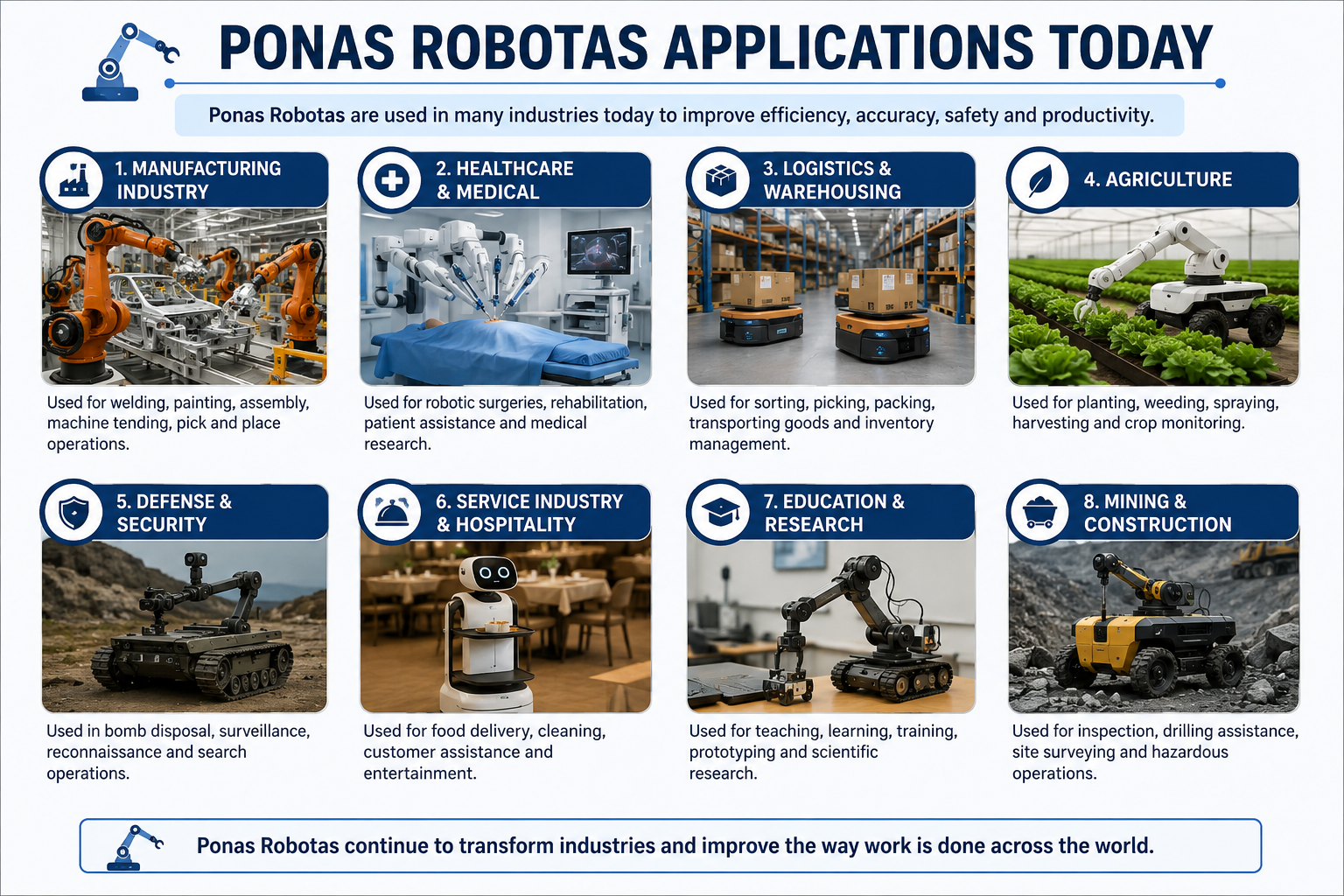
ponas robotas applications span smart home automation, healthcare robotics, industrial manufacturing, agriculture, and elderly care with real robots delivering measurable results today. In homes, robots like Ebo (Enabot) provide security monitoring and pet interaction while learning daily routines to assist disabled or elderly residents maintaining independence longer.
Healthcare uses ponas robotas for sub-millimeter precision surgery, AI diagnostic assistants analyzing medical images, and Moxi robots reducing nurse workload by 30% through supply delivery. Boston Dynamics Stretch automates warehouse palletizing, Tesla Optimus handles assembly line tasks at BMW, and Agile One deploys in automotive factories replacing $35,000–$50,000/year labor with $16,000–$80,000 robots.
Industrial manufacturing achieves 30–70% fewer defects with ponas robotas using computer vision identifying quality issues humans miss. Agriculture uses self-driving tractors and drone swarms eliminating 20–30% more chemicals through precision application. Last-mile delivery employs Alepa’s Starships autonomous units in Finland since April 2022 delivering food directly to homes.
The human touch remains essential best systems supplement people rather than replace them, creating new roles in programming, maintenance, ethics oversight, and creative direction while machines handle dangerous repetitive tasks.
Ponas Robotas Advantages and Benefits
ponas robotas advantages include 24/7 operation without fatigue, precision exceeding human capability, learning from experience to improve performance, and reducing workplace injuries by handling dangerous tasks. Robots work continuously without breaks, maintain consistent quality across millions of repetitions, and adapt to new situations through reinforcement learning rather than requiring reprogramming.
Healthcare benefits show ponas robotas enabling elderly people to take medicine按时, detecting falls immediately, and sending emergency alerts extending independent living by months or years. Manufacturing achieves fewer defects through computer vision spotting imperfections humans miss, while warehouses cut delivery times by automating palletizing and sorting operations.
Safety improvements occur when ponas robotas handles toxic waste cleanup, high-temperature die-casting, and heavy lifting traditionally causing worker injuries. The robots reduce exposure to hazardous materials while maintaining productivity levels humans cannot sustain safely over long periods. This protects workers while keeping operations running efficiently.
Cost efficiency emerges as manufacturing expenses dropped 40% from 2023–2024, with Tesla targeting $20,000–$30,000 per Optimus unit versus $50,000–$250,000 previously. Leasing options like 1X Neo at $500/month make ponas robotas accessible to smaller businesses without massive capital investment.
Energy consumption decreases when robots optimize routes and movements compared to human inefficiency, contributing to sustainability goals while maintaining output. The combination of precision, endurance, learning capability, and safety creates compelling value propositions across industries.
You May Also Read: Mustardland: Where ‘The Archers’ Fans Go to Overanalyze Radio Drama More Than Real Life
Ponas Robotas Challenges and Risks
ponas robotas challenges include safety concerns from 60–75kg machines moving at 8+ mph near humans, privacy issues from always-on sensors recording daily life, and potential job displacement affecting ~47M U.S. jobs in high-automation categories. These risks require regulation balancing innovation with protection, which Europe’s AI Act addresses through mandatory safety testing and data privacy requirements.
Cybersecurity vulnerabilities emerge when ponas robotas connects to IoT networks, potentially allowing hackers to control physical machines or access sensitive data captured by cameras and sensors. The Mr. Robot TV series warned about this without human values guiding machines, technology becomes control rather than liberation. Real hacking techniques shown in the program mirror actual vulnerabilities in robotic systems.
Ethical dilemmas arise around autonomous decision-making in life-or-death scenarios, bias in AI training data affecting performance across demographics, and accountability when robots cause harm. Lithuania’s regulatory sandbox approach provides mature regulation supporting innovation while protecting people through testing before full deployment.
Cost remains barriers despite decreases $20,000–$30,000 is still significant for small businesses, and maintenance requires specialized technicians not widely available. Technical limitations include robots struggling with unpredictable environments requiring human creativity, emotional intelligence gaps preventing genuine empathy, and battery life restricting continuous operation.
Unresolved risks include privacy erosion from constant surveillance, job displacement without adequate retraining programs, and potential weaponization of autonomous systems. The International Federation of Robotics recommends collaborative robots (cobots) working side-by-side with humans rather than replacing them entirely.
You May Also Read: TVLIO Online Streaming Platform for Entertainment, Movies, and Digital Content Access
Ponas Robotas Future 2026 to 2030
ponas robotas future trends point toward more intelligent, affordable, and human-friendly robots by 2030, with widespread humanoid companions in homes, fully autonomous supply chains, and robots learning ethical reasoning alongside technical skills. Tesla plans scaling Optimus from 5,000 units in 2025 to 50,000 in 2026, targeting 1 million annual production capacity.
Humanoid robot deployment crossed the threshold in under 24 months from barely walking to backflips, coffee pouring, and laundry folding. By late 2026, factory rollouts scale with Figure 2 at BMW and Agile One in automotive, while Dexterity leaps include Kyber Labs threading needles and Magic Lab Z1 performing acrobatics.
The market projection reaches $10 trillion by 2035 as hybrid human-robot teams address climate change, space exploration, and personalized medicine. Lithuania shows how intelligent policy creates robotics flagbearers with 2,400+ service robots already operating, particularly high density in electronics and furniture industries.
Voice recognition improvements enable better speech understanding, natural interaction becomes standard, and cost continues dropping toward $10,000 per unit making ponas robotas accessible to consumers. AI Overviews and ChatGPT Health integrate with robots providing medical advice and personalized guidance.
Conclusion
ponas robotas represents the emergence of intelligent robotic systems learning, adapting, and working with humans in homes, hospitals, and factories worldwide. The most important insight is that this technology arrived faster than expected 40% cost reduction in one year proves manufacturing breakthroughs accelerating deployment beyond predictions.
ponas robotas combines artificial intelligence, machine learning, computer vision, and natural language processing creating robots reading your environment, understanding commands, and improving through experience. Your next step is exploring Boston Dynamics Spot, Tesla Optimus, or Figure AI prototypes through official websites to understand real capabilities before purchasing decisions.
Frequently Asked Questions
How much does ponas robotas cost?
ponas robotas costs range from $300 for home security robots like Amazon Astro to $20,000–$30,000 for humanoid units like Tesla Optimus. Leasing options include 1X Neo at $500/month making ponas robotas accessible without massive capital investment for smaller businesses evaluating automation.
Is ponas robotas safe to use around humans?
ponas robotas safety depends on proper implementation with collision avoidance sensors, speed limits near people, and emergency stop mechanisms. Robots like Boston Dynamics Spot operate safely in factories, but 60–75kg machines at 8+ mph require regulation including Europe’s AI Act mandatory safety testing before deployment.
What is ponas robotas vs traditional robots?
ponas robotas differs from traditional robots by using artificial intelligence learning from experience rather than following fixed programs. Traditional robots need reprogramming for new tasks while ponas robotas understands natural language commands and adapts through reinforcement learning improving performance autonomously.
Can ponas robotas replace human jobs?
ponas robotas will transform jobs rather than simply replace them, creating new roles in programming, maintenance, ethics oversight, and creative direction while handling dangerous repetitive tasks. Approximately 47 million U.S. jobs face high automation risk, but retraining programs and collaborative robot approaches mitigate displacement concerns.
How does ponas robotas relate to the Mr. Robot TV show?
ponas robotas is the official Lithuanian title for USA Network’s Mr. Robot series airing 2015–2019, but the term expanded describing real AI robotics by 2024–2026. The show predicted ethical dilemmas about machine control correctly, and its cultural recognition helped popularize intelligent robotics conversations globally.
About the Author