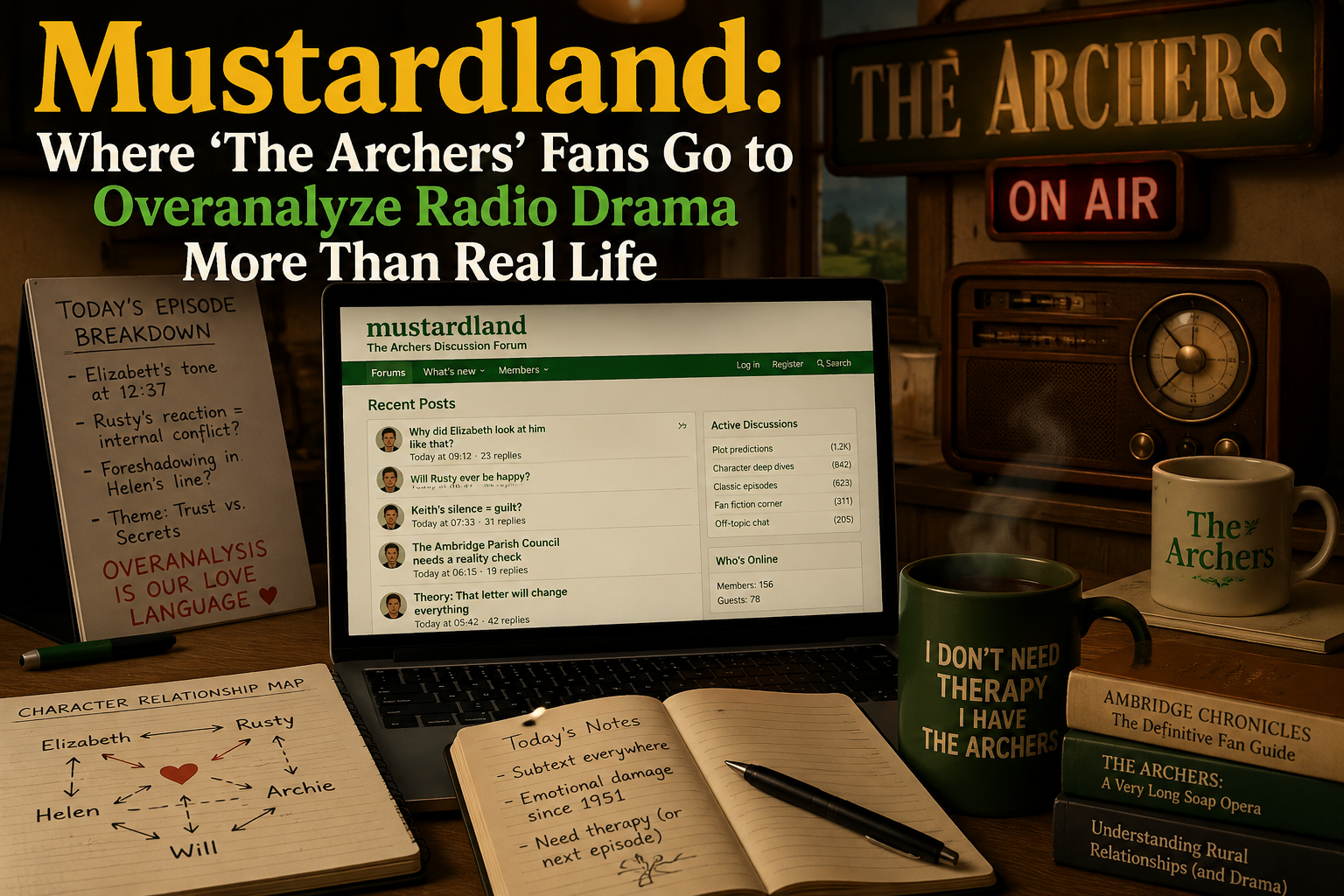
Mustardland is the affectionate, long-standing internet nickname for the official BBC message boards and subsequent independent forums dedicated to the obsessive analysis of the BBC Radio 4 soap opera The Archers. For over two decades, this highly specialized digital space has served as the central hub where thousands of dedicated listeners gather daily to dissect the multi-generational family dynamics of Ambridge, debate the realism of rural farming storylines, and critique the performance of the voice actors. Because the platform attracts a demographics of deeply knowledgeable listeners, the discussions on Mustardland frequently reach levels of structural and psychological analysis that rival serious literary criticism, making it a unique cultural phenomenon in the landscape of British radio fandom.
Why Ambridge Drama Triggers Intense Psychological Speculation on Mustardland
The psychological complexities of the residents of Ambridge provide endless material for listeners because the slow-burning nature of radio drama allows character flaws to develop over decades. On Mustardland, these fictional behaviors are analyzed with the same intensity usually reserved for real-world psychological case studies, as users track multi-year behavioral patterns across generations of farming dynasties. This deep dive into the minds of characters is not just casual gossip; it is a collaborative effort to map out the unwritten motivations driving the citizens of Borsetshire.
When a character like Tom Archer or Helen Titchener makes a controversial decision, the reaction on the message boards is instantaneous and highly clinical. Users do not merely state whether they like or dislike a storyline; they dissect the historical family trauma that explains the behavior. For example, a thread discussing a minor disagreement at Bridge Farm can quickly evolve into a 50-post analysis of how maternal rejection in the 1990s shaped a character’s current financial anxieties.
The unique layout of Mustardland fosters this environment by allowing long-form, text-heavy responses where users quote past episodes from memory or look up archival synopsis data. This repository of shared community knowledge means that a user cannot simply throw out a wild theory without being met with historical counter-evidence from twenty years ago. The community acts as an unofficial archivist of human behavior, holding the writers accountable to the psychological profiles established over the show’s seventy-year history.
Ultimately, this level of intense speculation satisfies a human desire for narrative order that real life rarely provides. By treating the inhabitants of a fictional village as real psychological subjects, the members of the forum can debate morality, ethics, and relationships within a safe, structured framework. The ongoing discussions prove that for a true fan, the internal world of the drama is a complex mirror of human nature that deserves rigorous, ongoing investigation.
You May Also Read: safetrode.com: Next-Gen Grounding, Bio-Medical Sensors, and IoT Protection
The Common Thread Tracking Mistakes That Disrupt Mustardland Lore Debates
The most significant pitfall for anyone engaging in historical debates on the forum is relying on recent memories or wiki summaries rather than the actual broadcast continuity of the program. Within Mustardland, historical accuracy is the ultimate currency, and misattributing a plot point from a 1985 episode or confusing the lineage of the Pargetter family can instantly invalidate an otherwise compelling argument. Newcomers and casual posters frequently stumble because they underestimate the encyclopedic memory of the core community members who have listened to the show for forty years.
A major point of friction occurs when users try to analyze current character motivations while ignoring the systemic changes made by past script editors. For instance, character traits that were established during the highly dramatic Vanessa Whitburn era are often viewed through a different lens than those written under the more traditional management of John Reynolds. When a forum member overlooks who was running the show at the time of a major character shift, their analysis lacks the structural context that the veteran board members value.
To avoid being corrected publicly, users must learn to verify their claims using cross-referenced fan databases before posting definitive statements. The community has little patience for repetitive threads that ask questions already answered in the extensive forum archives. A mistake as simple as getting the ownership history of Home Farm wrong can derail a thread completely, turning a structural discussion about agricultural policy into a pedantic correction match.
Mastering the lore requires an understanding that the show’s history is a living document with internal contradictions caused by decades of shifting writing teams. The seasoned critics on the board know how to spot these continuity errors and separate genuine character development from poor script editing. For the community to take an analytical theory seriously, the poster must demonstrate a comprehensive awareness of both the on-air history and the behind-the-scenes production decisions.
Evaluating the Digital Transition from the BBC Message Boards to Independent Formats
The structural migration of the community from the old BBC-hosted message boards to independent software platforms changed how fans interact, archive data, and moderate discussions. When the BBC shut down its official interactive message boards in 2011 as part of a sweeping cost-cutting measure, the community faced a sudden displacement that threatened to destroy a decade of digital culture. The birth of the independent Mustardland forum was an emergency response by users who refused to let their analytical community vanish into the digital archive.
The original BBC platform had strict formatting limitations, restrictive word counts, and heavy-handed automated moderation that often stifled deep thematic analysis. Moving to independent bulletin board software allowed the community to create specialized sub-forums, implement custom avatars, and remove the corporate constraints that limited their debates. This technological shift actually increased the volume of long-form analytical writing, as users were no longer restricted by the rigid structures of a public broadcaster’s website.
However, running an independent forum brought logistical hurdles that the community had never faced before, including hosting fees, software updates, and the necessity of self-moderation. The transition forced a group of radio fans to become web administrators overnight, balancing the preservation of free speech with the prevention of toxic forum warfare. Over the years, the platform has had to adapt its infrastructure multiple times to combat spam bots and ensure data security for its aging user base.
The comparative breakdown below highlights how the technical architecture of these different fan spaces directly influences the depth, tone, and longevity of the discussions surrounding the radio drama.
To understand how the community evolved, it is necessary to examine the physical environments where these fans have gathered over the decades. The choice of platform determines not just how easy it is to post, but who controls the narrative history of the fandom.
| Platform Type | Moderation Style | Archive Longevity | Text Formatting Options | User Autonomy Level |
|---|---|---|---|---|
| Official BBC Boards (Pre-2011) | Strict, corporate, automated filters | Non-existent (all data deleted upon closure) | Basic plain text, low word limits | Very low, subject to sudden corporate deletion |
| Independent Forum (Mustardland) | Community-led, peer-reviewed, fluid | Permanent, searchable multi-year threads | Advanced BBCode, quotes, images, tables | High, community-owned infrastructure |
| Social Media Groups (Facebook/X) | Algorithm-driven, reactive, minimal | Low, posts disappear down the live feed | Limited to short blocks, high media focus | Medium, bound by third-party terms |
| Reddit Communities (r/TheArchers) | Upvote/downvote system, user-moderated | High, but sorting favors recency over history | Markdown support, threaded comments | Medium, template-driven structure |
| Private Chat Groups (WhatsApp/Discord) | Invite-only, unmoderated peer groups | Ephemeral, difficult to search historically | Basic formatting, rapid real-time messaging | High within the closed group walls |
The structural takeaway from this technical evolution is that corporate-owned spaces are inherently unstable environments for preserving specialized fan culture. By taking full ownership of their digital infrastructure, the creators of the independent Mustardland platform ensured that twenty years of detailed cultural analysis remained accessible, searchable, and entirely independent of external media strategies.
You May Also Read: DigitalConnectMag.com Explained: Features, Content, and User Experience
What a Week of Tracking Agricultural Policy on Fan Forums Costs in Mental Labor
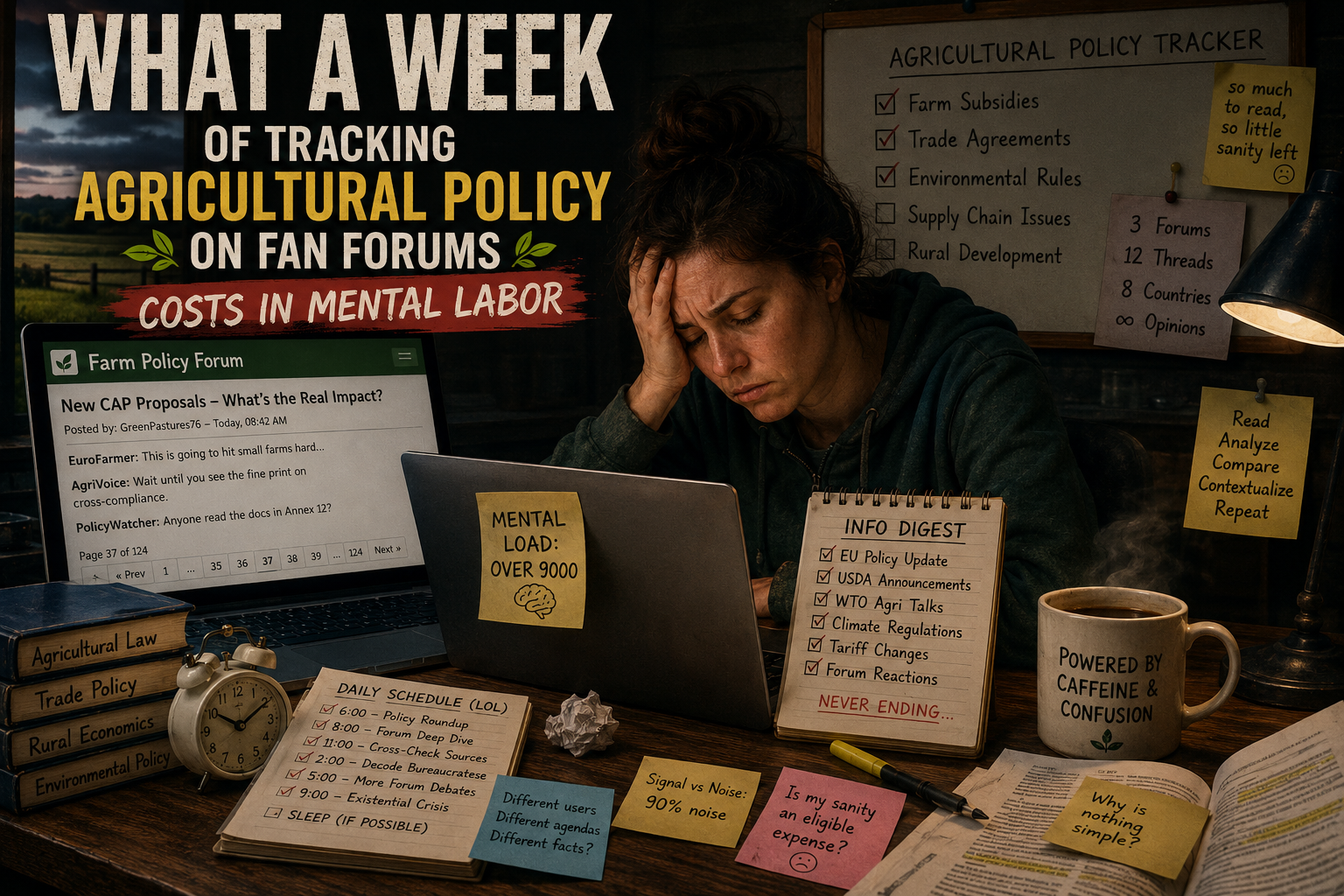
Analyzing the agricultural realism of the program requires a significant amount of invisible intellectual labor, as users cross-reference real-world farming regulations with the fictional business decisions of the Borchester landowning class. A single episode featuring a debate about crop rotation, milk yields, or environmental land management schemes can generate pages of technical discussion on Mustardland within hours of broadcast. For the farming experts and passionate amateurs on the board, pointing out an inaccuracy in David Archer’s silage management is a serious intellectual pursuit.
This level of monitoring requires listeners to stay informed about actual UK farming legislation, Department for Environment, Food and Rural Affairs (DEFRA) policies, and global commodity pricing markets. When the scriptwriters introduce a plotline about a new robotic milker or a rewilding project, the forum members immediately evaluate the capital expenditure against real-world farming budgets. This means that a user must possess or research advanced knowledge of agricultural economics just to participate in the core narrative critiques.
The mental energy spent on this validation process is driven by a desire for narrative verisimilitude in public broadcasting. Because the show was originally conceived in 1951 as a tool to educate farmers and boost food production, the community believes the production team has a moral obligation to maintain technical accuracy. When the show prioritizes sensationalist interpersonal drama over realistic farming dilemmas, the forum experiences a collective frustration that manifests as highly technical counter-arguments.
Consequently, reading through these threads offers an alternative, highly educational commentary that exposes the gaps between urban media production and rural reality. The community provides an ad-hoc fact-checking service that holds the BBC to its educational mandate, proving that entertainment and technical critique are inseparable for this audience. This rigorous oversight transforms the simple act of listening to a radio play into an active, demanding intellectual exercise.
How Beginners Can Navigate the Complex Social Hierarchies of Specialized Drama Forums
For a new listener attempting to join the conversation, entering the established social structure of the forum can be an intimidating experience due to the decades of inside jokes, acronyms, and unspoken rules. The social hierarchy on Mustardland is built entirely on historical knowledge and consistency of analysis rather than simple post counts or flashy profiles. A newcomer who bursts into a thread demanding basic plot summaries will likely be ignored or politely directed to the search function, as the community expects a baseline level of independent research.
To integrate successfully, a beginner must first decode the complex lexicon used to describe the characters and production crew. Acronyms for long-dead characters, derogatory nicknames for current script editors, and shorthand references to specific real-world locations are thrown around without explanation in every thread. Spending several weeks lurking and reading through older archival material is the only reliable way to learn the linguistic landscape of the community without making an embarrassing social misstep.
Another common error made by new posters is taking the forum’s intense cynicism at face value and assuming the community hates the show. In reality, the harsh critiques found on the message board are a manifestation of deep, multi-decade affection; only someone who loves a program unconditionally will spend hours writing a thesis on why a secondary character’s dialogue was poorly paced. Understanding this paradox is crucial for survival on the board, as a beginner who launches into unconstructive bashing of the show will quickly find themselves alienated by the core group.
The optimal strategy for a new user is to contribute specific, well-researched insights to ongoing threads rather than starting generic new topics. By offering value—such as a real-world perspective on a legal issue or an accurate historical recollection—a newcomer can earn the respect of the forum veterans. Joining this unique ecosystem requires patience, respect for the collective memory, and an acceptance that on this platform, the fictional history of Borsetshire is treated with the seriousness of a real academic discipline.
You May Also Read: Ellendewittrealestate.com: Your Trusted Gateway to Premium Property Listings
What the Real-World Outcomes of Long-Term Script Criticism Look Like on Public Broadcasters
The collective critiques generated by specialized fan communities like Mustardland do not exist in a vacuum; they have historically influenced the production values, casting choices, and narrative directions of public broadcasters. While the BBC rarely admits to changing a storyline based on internet feedback, current and former production staff have acknowledged that they monitor the major fan forums to gauge audience sentiment. The highly articulate, specific nature of the feedback found on the independent board makes it a far more valuable resource for script editors than the generic praise or anger found on broader social media platforms.
When a storyline becomes universally unpopular on the forum due to poor pacing or a lack of realism, the compounding weight of that criticism often mirrors broader institutional shifts within Radio 4 management. For example, during extended plotlines that alienate traditional listeners, the detailed breakdowns on the board provide a clear diagnostic map of exactly where the narrative structure is failing. This critical consensus can accelerate editorial course corrections, leading to the quiet wrapping up of unpopular scenarios or a return to traditional rural themes.
Furthermore, the platform serves as an early-warning system for the BBC regarding issues of cultural representation, accuracy in sensitive storylines, and the handling of complex social issues. When the show tackled the landmark domestic abuse storyline involving Helen and Rob Titchener, the real-time tracking on the board provided a profound record of how the public processes complex psychological trauma. The nuance of these discussions often informs the educational resources and follow-up programming that the BBC pairs with high-impact radio drama.
The real-world outcome of this continuous feedback loop is a more resilient, accountable piece of public media that cannot easily detach itself from its core audience. The forum acts as an unofficial advisory panel, reminding the creators that their audience is highly educated, attentive to detail, and fully capable of organizing sophisticated critical responses. This relationship demonstrates that modern fan communities are active participants in the preservation and evolution of traditional broadcast art forms.
The Specific Narrative Scenarios Where Micro-Analysis Succeeds vs Where It Completely Fails
Micro-analysis on the forum reaches its highest utility during complex, multi-layered storylines involving financial fraud, legal battles, or intricate historical inheritances where the details matter immensely. When a character attempts a corporate takeover of a local business or navigates a complicated probate dispute after a family death, the professional diversity of the Mustardland user base shines. Lawyers, accountants, and industry experts within the community break down the legal and financial logistics of the plot, pointing out exactly where the script aligns with real British law and where it takes creative liberties.
In these specific scenarios, the community’s obsession with detail enhances the listening experience for everyone, turning a confusing sub-plot into an engaging lesson in real-world systems. Users track every asset movement, evaluate contractual language mentioned on air, and predict the outcome of courtroom scenes with startling accuracy based on historical legal precedents. Here, the hyper-fixation on minutiae adds immense value, providing a layer of critical commentary that the BBC’s official promotional materials completely overlook.
Conversely, this micro-analytical approach fails completely when applied to romantic storylines, creative character re-castings, or necessary narrative shortcuts designed for dramatic pacing. When the forum attempts to apply rigid logic and historical consistency to the unpredictable nature of human romance or sudden casting changes due to actor health, the discussions become pedantic and detached from artistic reality. A thread analyzing why an eighteen-year-old character suddenly speaks with a slightly different accent after a recast ignores the basic operational realities of producing an industrial-scale radio diary six days a week.
The failure mode occurs when the community mistakes a conventional dramatic device for a deliberate plot point or a failure of the writing team. When listeners demand absolute realism from a medium that requires suspension of disbelief, the joy of storytelling is replaced by an algorithmic audit. Recognizing the boundary between a storyline that benefits from structural critique and one that requires simple emotional engagement is the key to maintaining a balanced perspective within the fandom.
Conclusion
Mustardland remains a vibrant testament to the power of specialized digital spaces, demonstrating how a shared passion for a single radio program can foster a highly literate, self-sustaining intellectual community. By tracking agricultural policy, analyzing character psychology, and archiving decades of narrative continuity, the members of the forum have elevated the act of media consumption into a collaborative art form.
While their hyper-focused debates can occasionally veer into pedantic territory, the structural oversight they provide keeps the longest-running radio drama in the world grounded, accountable, and deeply connected to its cultural roots. For anyone looking to understand the true impact of public broadcasting on national identity, observing the ongoing debates within Mustardland offers an unvarnished, fascinating window into the mind of the British public.
You May Also Read: GoredPocket.com Review 2026: Features, Benefits, and Hidden Details Revealed
FAQs
What is Mustardland and why is it called that?
Mustardland is the popular, long-running online forum where fans of the BBC Radio 4 soap opera The Archers gather to discuss, analyze, and critique the show’s ongoing storylines and characters. The unique name originally derived from a piece of old internet history related to the formatting and color schemes of the early independent message boards that the community adopted after migrating away from the official BBC website.
Is Mustardland an official BBC website for fans?
No, Mustardland is a completely independent, user-run fan community that has no official affiliation, corporate backing, or structural connection to the BBC or the production team of The Archers. The platform was created entirely by independent listeners who wanted a self-moderated space to preserve their archive of deep script analysis without the restrictions imposed by corporate public broadcasting regulations.
How do I join the conversations on Mustardland safely?
To participate in the discussions safely, you should register an account on the independent bulletin board, read the community guidelines carefully, and spend time observing the existing threads to understand the local etiquette. It is highly recommended that you search the historical archives before starting new topics to ensure your question has not already been thoroughly analyzed by long-term members.
Why are the critiques on Mustardland often so negative?
The intense scrutiny and sharp critiques found on the platform are actually a reflection of the community’s deep, long-standing affection for the show rather than genuine malice. Because the core user base consists of highly knowledgeable, multi-decade listeners, they hold the scriptwriters to exceptionally high standards regarding continuity, agricultural accuracy, and psychological realism.
Can beginners share their opinions on Mustardland threads?
Yes, beginners are entirely welcome to share their perspectives on the forum, provided they approach the established community with respect for its history and ongoing conversations. Contributing specific observations about recent episodes or asking well-considered questions about the complex family lineages of Ambridge is an excellent way for a new user to start building a positive reputation among the veteran posters.
About the Author